
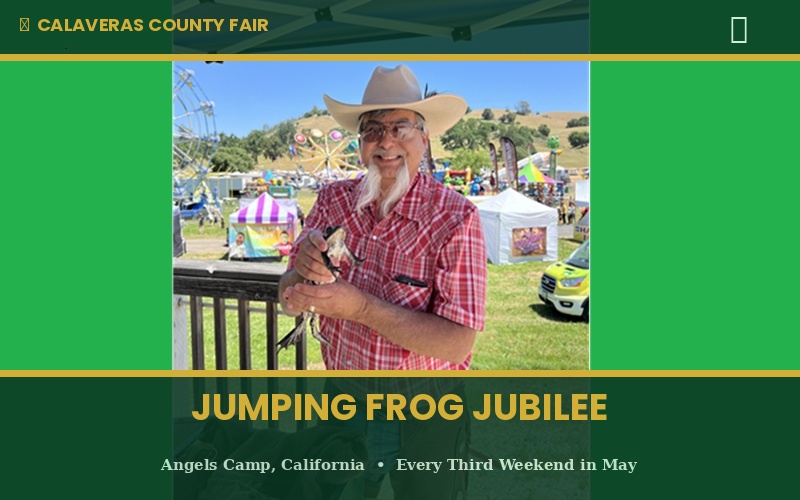
How a Mark Twain tall tale became one of California’s most beloved and delightfully absurd annual traditions
Held every third weekend in May · Frogtown, Angels Camp, CA
Somewhere between a literary pilgrimage and a full-on country fair, the Calaveras County Fair and Jumping Frog Jubilee is one of those American events that sounds like it shouldn’t work — and yet, somehow, draws up to 50,000 visitors every single year. If you’re anywhere near California’s Gold Country in mid-May and you haven’t been, you’re missing out on something genuinely special.
It all started with Mark Twain (and a very soggy afternoon)
The story begins in January of 1865, when a young, broke, and somewhat desperate Samuel Clemens — not yet the legendary Mark Twain — found himself stranded in Angels Camp during a relentless rainstorm. Holed up at the Angels Hotel, he passed the time listening to miners swap tall tales over drinks. One story stuck: a yarn about a gambler named Jim Smiley and his champion jumping frog, Dan’l Webster.
That tale, “The Celebrated Jumping Frog of Calaveras County,” was published in the New York Saturday Press on November 18th, 1865 — and it launched Mark Twain’s career. What’s remarkable is that a small Gold Country town effectively gave America one of its greatest writers his first big break, and never let him forget it.
From paved roads to frog jockeys: the Jubilee is born
Fast forward to 1928. Angels Camp was celebrating a momentous occasion: the paving of its Main Street. Local boosters, many with personal connections to Twain’s memory, decided the best way to mark the occasion was to actually hold a frog jumping contest — a living tribute to the story that put their town on the map. More than 15,000 visitors showed up. It was a hit.
Two years later, the contest merged with the Calaveras County Fair (itself one of California’s oldest, dating back to 1893), and the combined event settled into its permanent home at the Calaveras County Fairgrounds — now affectionately known as Frogtown. It’s been held every third weekend in May ever since, making it one of the longest-running fairs in the entire state.
So how does frog jumping actually work?
Here’s the thing that surprises first-timers: you absolutely cannot train a frog. The entire sport is built around unpredictability. Contestants — called “frog jockeys” — place their frog on a starting lily pad and then do whatever it takes (short of touching the frog) to urge it forward. Shouting, stomping, singing, dancing, blowing — all fair game. The frog’s three jumps are measured in a straight line from start to finish.
Throughout the four-day event, frogs compete on the main stage, with the top 50 qualifiers advancing to the International Frog Jump Grand Finals held every Sunday at 3:00 PM. Anyone can participate, and if you didn’t pack your own amphibian, frogs are available to rent.
The record to beat belongs to Rosie the Ribeter, who leapt 21 feet and 5¾ inches in 1986. Nobody has come close in nearly 40 years — and the $20,000 prize still waits unclaimed.
California Fish & Game has overseen the contest since 1933 to ensure every frog is treated humanely. After the competition, all rental frogs are safely returned to their natural habitat.
Beyond the frogs: a proper Gold Country fair
The Jubilee is far more than its headline act. The four-day weekend kicks off with a children’s parade through historic downtown Angels Camp and wraps up Sunday evening with a crowd-pleasing demolition derby. In between, you’ll find the Frogtown Rodeo (with champion bull riders and a kids’ buckaroo competition), live music, carnival rides, classic fair food, and junior livestock auctions. It’s the kind of fair that feels like it belongs to another era — in the best possible way.
Planning your visit:
- Buy tickets in advance at frogtown.org to skip the lines — 1-day and 4-day passes available
- Parking is cash-only at the gate, and 100% of proceeds go to the local youth sports program
- First-time frog jockeys can warm up on the Lily Pad practice stage before competing on the main stage
- Lodging fills up fast — options range from campgrounds on the fairgrounds to vacation rentals nearby
- The Jubilee is held rain or shine, third weekend of May, Thursday through Sunday
Why it still matters
In an age where events are endlessly manufactured for social media, there’s something genuinely refreshing about a tradition this old and this weird. The Calaveras County Jumping Frog Jubilee has been going strong for nearly a century because it’s rooted in something real: a place, a story, a community that took one rainy afternoon and a broke young writer’s notebook and turned it into a living legend. The frogs don’t care about any of that, of course. But the rest of us do.